
Ahmadiyya Beliefs

Overview The Ahmadiyya Muslim Community is a community of Muslims who believe that Mirza Ghulam Ahmad of Qadianas (1835-1908) was the Promised Messiah and Imam Mahdi. Ahmadis believe that he was the foretold reformer for the latter days, promised in both Islamic and non-Islamic religious texts. For while it exults in material progress, the world finds itself in an age of spiritual darkness. Ahmad claimed to be the light for this age, to guide seekers of truth into spiritual enlightenment. His followers now number in the tens of millions, spread over 200 countries of the world. Though they are persecuted bitterly in some parts of the globe, and deemed heretical by many an established cleric, their cause continues to find progress in every quarter of the globe. Having translated the Holy Qur’an into over 70 languages, their mission is to spread the original peaceful teachings of Islam throughout the world. The community has now 4 international satellite television channels, spreading the peaceful and rational message of the Prophet Muhammadsa throughout the globe. Its literature and missionary efforts have been hailed as pioneering in the USA, Europe and Africa in particular. In recent years, the message of the Promised Messiahas has become more widely heard in the Middle East, with unprecedented numbers of Arabs joining. What can explain the success of such a religious community, perhaps the only in the world to rely entirely on the donations of its own adherents? How can we explain the success of a spiritual movement that is bitterly opposed by many governments and religious orders alike? Perhaps the answer lies in divine support for a refreshingly rational and peaceful presentation of Islam, with a message that satisfies the mind and moves the heart. Beliefs This page will explore the beliefs of Ahmadi Muslims, exploring both similarities and differences with our Non-Ahmadi ‘Sunni’ and ‘Shia’ brothers and sisters. A brief summary follows: Ahmadi Muslims believe in the Five Pillars of Islam, the Six Articles of Faith, the superiority of the Qur’an over all other texts, the station of Muhammadsa as Seal of the Prophets, the pre-eminence of the Rightly-Guided Khulafa, the high station of the Prophet’ssa companions, and all the other major aspects of Islam agreed upon by the 4 major schools of Sunni Islam. We also believe in the lofty station of the immediate descendants of the Holy Prophet Muhammadsa , while not ascribing inherent divine leadership to them. Ahmadi Muslims differ from contemporary Sunni & Shia Muslims in a few important areas: Death of Prophet Jesusas Ahmadi Muslims believe that Jesusas was a Prophet like other Prophets. As such, we do not accept the idea held by many clergy today that Jesusas has ascended to heaven, and is waiting to return with sword in hand, to herald a bloody end to the world. Ahmadi Muslims deem this belief a dishonour to the peaceful and rational teachings of Islam, and trace this belief’s origin in Muslim thought to an era long after that of the Prophet Muhammadsa , when great numbers of Christians entered into the fold of Islam. Such beliefs find no basis in the Qur’an or the authentic traditions of the Qur’an and are in fact refuted by them. Based on Qur’anic, Biblical, and historical records, Ahmadis believe that Jesusas survived the crucifixion attempt on his life, escaped the clutches of the Roman Empire, and fled East to the lands of Tibet and India. There he preached to the lost tribes of the House of Israel, before dying at the age of 120 in Kashmir. There his tomb is to be found, venerated by the local population as the tomb of Jesusas , who visited the land 2000 years ago. Second Coming of Jesusas There is a clear prophecy in the Qur’an about the second appearance of the Prophet Muhammadsa in the Latter Days. There are also explicit prophecies of the Prophetsa regarding the Second Coming of the ‘Messiah, Son of Mary,’ as well as references to the arrival of the ‘Imam Mahdi.’ To Ahmadis, all these prophecies relate to different aspects of the same Prophetic figure in this era. As Jesusas has passed away, the ‘second coming of the Messiah’ can only have a metaphorical and symbolic meaning: in the same way that Jesusas was the Messiah for the Jews in the 14th century after Moses, the prophecy foretells a messianic figure for the Muslims appearing in the 14th century after the Prophet Muhammadsa . The character of both respective communities would be similar. The Jews in the time of Jesusashad become extremists, with many supporting a terrorist movement known as the Zealots who sought to overthrow the ruling Roman Empire and establish a Jewish state. In the same way, the Muslim clergy of today adhere to extremist beliefs, often showing support to extremist groups who seek to overthrow western government by violent means. Moreover, the metaphor of the ‘Second Coming’ indicated that the character of the respective Messiahs would be similar. Whereas Jesusas came with a teaching of compassion and tenderness to a hard-hearted Jewish nation, so too would the Muslim Messiah come with a teaching of peace and sympathy to a hard-hearted Muslim nation. Thus the Second Coming was symbolic, indicating that there would be a spiritual affinity between the Jewish Messiah and the Muslim Messiah. Not only this, but Ahmadis believe that the prophecies of the Imam Mahdi indicate that he would also be the Messiah, and would be a spiritual manifestation of the Prophet Muhammadsahimself. Taken together, both the Qur’an and the narrations tell us that the Mahdi and the Messiah are two aspects of the same individual. This individual would be a spiritual reflection of the Prophet Muhammadsa himself. For Ahmadi Muslims, that individual was the Mirza Ghulam Ahmad of Qadianas . Finality of Prophethood The Holy Qur’an calls the Prophet Muhammadsa the ‘Seal of the Prophets’. It is often claimed that Hazrat Mirza Ghulam Ahmadas contradicted this by claiming to be a Follower-Prophet himself. This is a misconception based on the idea that the term the ‘Seal of the Prophets’ means that there would be literally no
Future of Ahmadiyya in Nigeria: Beyond the first century

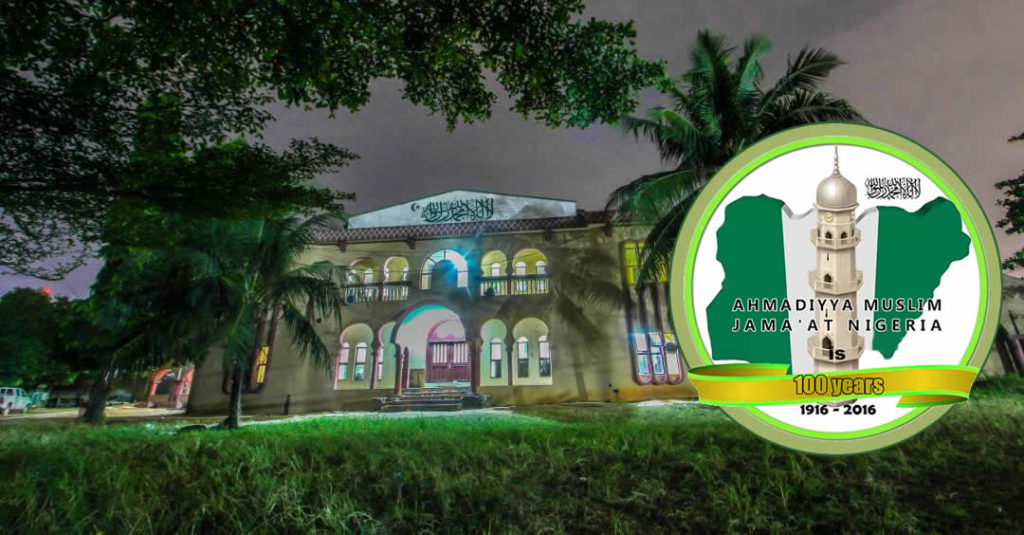
The root of Ahmadiyya Nigeria Muslim Jamaat was planted in 1916 when the spread of the message of the Promised Messiah, Hazrat Ghulam Ahmad was brought to the newly amalgamated Northern and Southern protectorates in Nigeria. Ahmadiyya took its root in 1889 in Qadian, now Pakistan while its flame has since spread the message of peace across all corners of the world. The 64th annual convention (Jalsa Salana) that marks our 100 years anniversary celebration calls for a deep reflection on the contributions of the Jamaat to Nigeria’s development. Ahmadiyya Muslim Jamaat has contributed immeasurably to the spread of Islamic teachings and moral parsimony in the most populous black nation since its debut in a century. With 493 branches across all states in the federation, the Jamaat has widespread acceptance and highest membership in Africa and ‘Top Ten’ among other nations across the world. Ahmadiyya has scored first in many areas of human endeavours in Nigeria. The Truth, the first Muslim newspaper established by the Jamaat in 1966 still publishes regularly till date. Muslim elementary and secondary institutions were pioneered for western, moral and Islamic teachings. In the area of healthcare, Ahmadiyya has contributed in no small measure with the establishment of hospitals, yet the first by any Muslim organization in Nigeria. Ahmadiyya youth has fully participated in virtually all youth programmes in Nigeria. Our members have excelled in all spheres of human endeavour. However, the theme of this convention, “Redefining Moral Revolution for Sustainable Peace and Development: Post-Hundred Years of Ahmadiyya in Nigeria” is a reflection of the current events in our ever-changing world replete with corruption, violence/terrorism and moral decadence. Without moral regeneration in our society today, there will be no meaningful development. Ahmadiyya Jamaat will continue to support efforts to redefine our moral revolution, including creating and maintaining sustainable peace and development. Ahmadiyya has taken giant leap in our quest to creating a nation devoid of vices inimical to our nation’s growth through the training of our youth on moral principles in our schools. We have sponsored radio and television programmes including periodic programmes organized for Nigerians irrespective of ethnic, political and religious affiliations to impart moral teachings. Our members are ambassadors who carry the message of peace in their daily endeavour, living up to our principle of “Love for All, Hatred for None”. Our nation’s growth is no doubt inhibited by myriad of vices that bedevil us. Redefining our moral principles must be done now to avert national calamity. The federal government’s effort to rid the country of corruption is a good step in the right direction. We however need to do more. Our school curriculum must be reviewed to include moral teachings for our pupils. The youth must be taught the creed of ‘hard work that pays’ to stem corruption while those who have pillaged our resources must be prosecuted and duly penalized having betrayed the trust reposed in them. Governments at all levels must be fair to all in accessing and distribution of nation’s resources. Equal employment opportunities and social security must be provided for our women, unemployed youth and the aged. Only in this way can we attain sustainable peace for meaningful development. Oguntayo is of the Publicity Committee, Centenary Celebration, Ahmadiyya Muslim Jamat, Nigeria. Read more at: https://www.vanguardngr.com/2016/11/future-ahmadiyya-nigeria-beyond-first-century/
100 years of Ahmadiyya in Nigeria: A brief appraisal
“…….and if He(Allah) intends good for thee, there is none who can repel His grace…….”(Q. 10: 108) The history of the establishment of the Ahmadiyya Muslim Jama’at in Nigeria in 1916 (formally), for there are some evidence of its having been heard of in the country as early as between 1913 and 1914), was more of circumstantial (borne out of the condition of the Muslims at the time) rather than as a result of a yearning for true religion (Islam) by most of the pioneering converts. This explains why some of the pioneer members broke away from the Jama’at between 1920 to 1924, on various flimsy excuses, to form their own groups/societies, even without having really had any fair understanding of what Ahmadiyyat was really about; having had just a little taste of the Jama’at Administrative standard from the first expatriate Missionary to Nigeria, Malana Abdur Raheem Nayyar. It needs to be recalled that the first five years of the establishment of the Jama’at in Nigeria (1916 -1921) was a period when it was the pioneer members, who were not yet trained in the principles and values (Nizam) of the Jama’at, who were the sole determiners and decision-makers on how the Jama’at was then to be run and at what pace, with little or no input from the Jama’at headquarters, then ONLY based in Qadian, India, which was also the Seat of the Khalifa. Their main and major contact with the headquarters during this early period was through some books and pamphlets being sent to them from Markaz for their guidance, and occasional letters or Tele/Cablegrams on some minor issues. In other words, though they signed the baiat of the Jama’at, they continued to administer the Jama’at along the same line in which they were administering their erstwhile Muslim Literary Society, which later metamorphosed into the foundation of the Jama’at; as there was no well-groomed Ahmadi Missionary to train them. This situation also, perhaps, explains why there was no record/evidence of the Jama’at ever spreading beyond the Lagos Island during this period. However, the establishment of the time it took place in Nigeria (1916 to be specific), twenty-seven years after its inauguration by Allah through the hands of the Promised Messiah (a.s.) in 1889, whatever form or coloration it might assume then, was a clear fulfillment of Allah’s assurance to the Promised Messiah (a.s.) in 1886 that: “I Shall convey thy message to all the corners of the earth.” It was also a vindication of the divine ordination of Hazrat Mirza Ghu-lam Ahmad as the Promised Messiah/Imam Mahdi (a.s.). After all, Allah Himself vows that: “If he had forged (and attributed) any saying to Us, We would Surely, have seized him by the right hand, And then, surely, We would have cut his life vein; And not one of you could have Held (Our Punishment) off him.” (Q. 69: 45 – 48) The First Test of Faith The first test of faith, loyalty, and commitment came on the…
